




I Am Sorry Gift Iznik Ceramic Mirror Set
Product Features
- Special metal workmanship.
- Decorated with shiny stones.
- Useful.
- High-quality and elegant.
- Same-day dispatch in the gift box shown in the image.
- Mirror length: 15.4 cm (6.062 inch), including the handle.
- Comb length: 12.2 cm (4.803 inch).
- Gift box size: 17 cm (6.692 inch) x 11.5 cm (4.527 inch) x 2.8 cm (1.102 inch).
- For international orders, your product is handed over to the shipping carrier with ultra-protective special packaging. Estimated delivery time is 3–7 business days for European countries and the United States, and 4–9 business days for other countries. Delivery times may vary depending on the shipping carrier, customs procedures, public holidays, and local delivery processes.
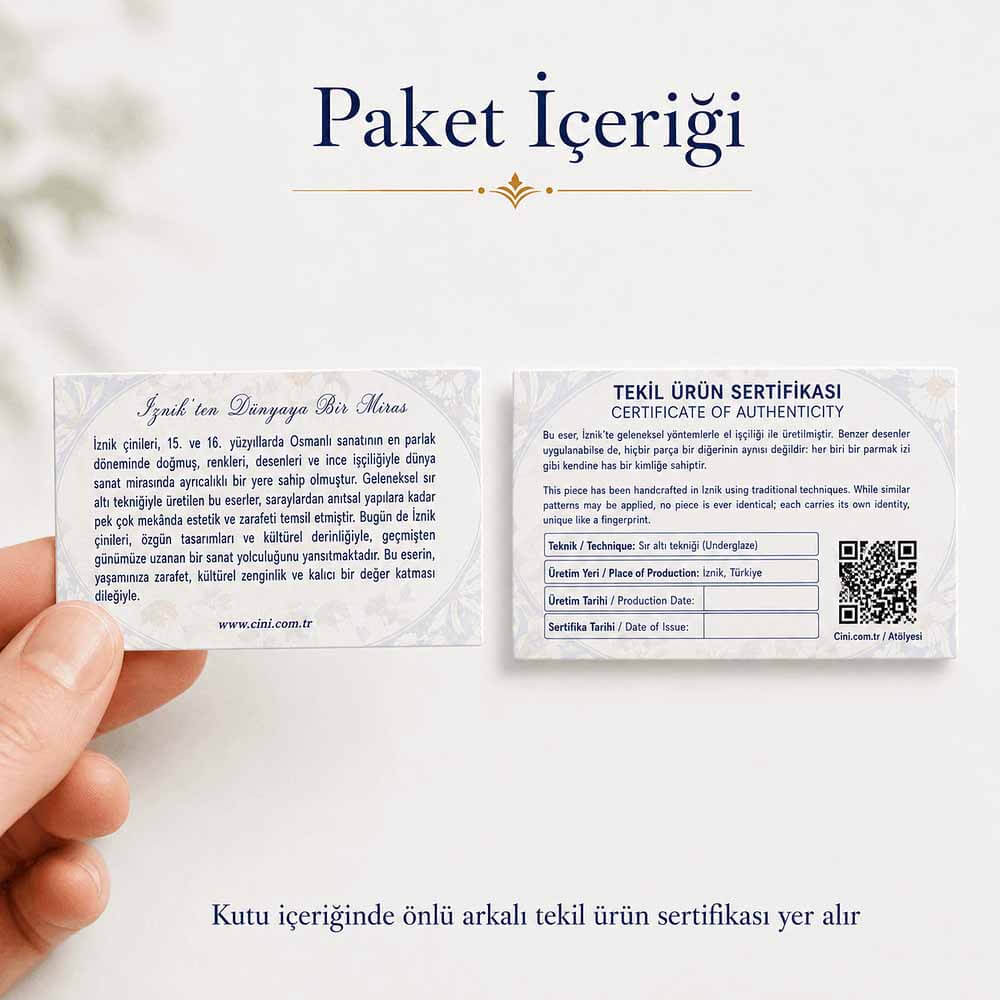
Each Iznik ceramic piece is unique, just like a fingerprint. Even if the same product is produced again in the same way, it will not be exactly identical.
The exact same piece you are viewing now cannot be produced again.
We recommend purchasing the product you like immediately if it meets your needs.
The value of Iznik ceramics never decreases, they never go out of fashion, and they do not become outdated. They are artistic heritage pieces that can be passed down from generation to generation.
Pattern Information: Tulip Motif
In Iznik ceramics, the tulip is seen as a symbol of love, beauty, and perfection. Because the Turkish word for tulip shares the same letters as the Arabic word Allah, it has also been associated with divine love. The tulip motif became especially prominent in Ottoman and Iznik ceramic art from the 16th century onward.
Love: The tulip is often seen as a symbol of love because of its delicate beauty and graceful form.
Beauty and elegance: The tulip is known as an elegant and aesthetic flower in nature. In Iznik ceramics, tulip motifs emphasize the beauty and elegance of ceramic craftsmanship.
Perfection: The tulip is often seen as a symbol of perfection because of its symmetrical form and balanced petals.
Divine meaning: The tulip is sometimes seen as a divine symbol because of its association with the Arabic word Allah.
Cycle of nature: The tulip is accepted as a herald of spring. In Iznik ceramics, tulip motifs symbolize natural cycles such as the revival of nature, rebirth, and growth.
Nobility and wealth: The tulip became an important symbol during the Ottoman Empire. Tulip motifs were used in Ottoman palaces and other important buildings, symbolizing nobility, power, refinement, and wealth.
Turkish culture and history: The tulip has an important place in Turkish culture and history. In the Ottoman Empire, tulips were grown in palace gardens and adopted as a symbol. Tulip motifs in Iznik ceramics represent the connection to Turkish history and culture.
Pattern Information: Meaning of the Vav Motif
The Elif motif in Iznik ceramics does not carry only a religious meaning. It also has aesthetic value. The elegant and simple design of the Elif motif adds a distinctive beauty to Iznik ceramics.
The Vav motif in Iznik ceramics represents the letter Vav, the sixth letter of the Arabic alphabet. Since it is also the initial letter of the words “existence” and “unity,” it has an important place in Islam. The Vav motif adds elegance to Iznik ceramics.
There are several meanings behind the use of the Vav motif in Iznik ceramics:
Existence: The Vav motif represents the unity of existence and that Allah is the source of everything. Since it consists of two vertical lines, it symbolizes the two aspects of existence, the material and spiritual worlds.
Unity: The Vav motif represents unity and oneness. The coming together of the two vertical lines symbolizes the unity of Allah and the unity of believers.
Love: The Vav motif represents love for Allah and creation. The embracing form of the two vertical lines symbolizes the love of Allah and the believers’ love for Allah.
Ascent: The Vav motif represents spiritual ascent and drawing closer to Allah. The two vertical lines extending upward symbolize the believer’s spiritual journey and effort to reach Allah.
The Vav motif in Iznik ceramics does not carry only a religious meaning. It also has aesthetic value. The elegant and simple design of the Vav motif adds a distinctive beauty to Iznik ceramics.
Pattern Information: Meaning of the Elif Motif
The Elif motif in Iznik ceramics represents the letter Elif, the first letter of the Arabic alphabet. Since it is also the first letter of the word Allah, it has an important place in Islam. The Elif motif adds elegance to Iznik ceramics.
There are several meanings behind the use of the Elif motif in Iznik ceramics:
Belief in monotheism: The Elif motif represents the Islamic belief in one God. Its depiction as a single upright line symbolizes that Allah is one and unique.
Unity of existence: The Elif motif represents the unity of existence and that Allah is the source of everything. Since it consists of a single line, it shows that all existence comes from Allah and is connected to Him.
Greatness and majesty: The Elif motif represents the greatness and majesty of Allah. Its depiction as a straight and long line symbolizes Allah’s infinite power and might.
Spiritual ascent: The Elif motif represents spiritual ascent and drawing closer to Allah. Its depiction as an upward line symbolizes the believer’s spiritual journey and effort to reach Allah.


