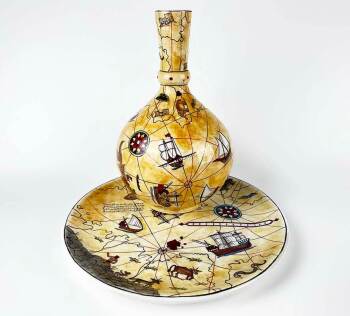
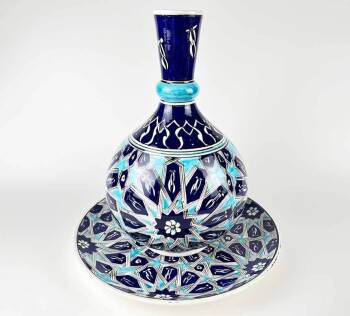
Night Garden Pattern Iznik Ceramic Vase and Plate Set
Out Of Stock
Notify me when it’s in stockNight Garden Pattern Iznik Ceramic Vase and Plate Set
Product Features
- Completely handmade Iznik ceramic vase and plate set.
- Ships the same day in a velvet-covered VIP wooden box.
- Produced with the Iznik ceramic underglaze technique.
- Plate diameter: 30 cm.
- Vase height: 30 cm.
- Fired at 800-1000 °C.
- Ultra-protective special packaging.
Pattern Information: Night Garden Motif
The night garden motif in Iznik ceramics is associated with love, beauty and peace. The motif is inspired by the gardens of the Ottoman Empire, which were known for their beautiful flowers, trees and fountains.
The meaning of the night garden motif is open to different interpretations. In Iznik ceramics, it is generally considered to symbolize nature and the cycle of life. It represents the vitality of nature, an enchanting atmosphere, tranquility and aesthetic beauty.
The night garden motif first appeared in Iznik ceramics in the 16th century. Ottoman gardens were places visited by sultans and their families, admired for their flowers, trees and fountains.
The motif became popular in Iznik ceramics because of its symbolic meaning, beauty and lasting decorative character.
In addition, the night garden motif is also seen as a symbol of love and loyalty. The flowers and trees in the garden may represent love between two people, while the fountains may symbolize devotion and faithfulness.
The night garden motif is a beautiful and timeless design that has been used for centuries to decorate homes and public buildings. It recalls Ottoman love, beauty and peace, while also symbolizing affection, loyalty and prosperity.
Pattern Information: Pomegranate Motif
The pomegranate motif in Iznik ceramics is a symbol of fertility, abundance and good fortune. The many seeds of the pomegranate are associated with plenty and prosperity, while its bright red color is often seen as a sign of good luck.
In Ottoman culture, the pomegranate was also associated with religious and cultural symbolism. Its many seeds were interpreted as representing abundance, unity and continuity.
The pomegranate motif first appeared in Iznik ceramics in the 16th century and became popular because of its symbolic meaning, beauty and durable decorative character.
Today, the pomegranate motif continues to be appreciated and appears in ceramic works, museums and private collections around the world.
Pattern Information: Tulip Motif
In Iznik ceramics, the tulip is regarded as a symbol of love, beauty and perfection. Because the Turkish word “lale” shares the same letters as the Arabic word “Allah,” it has also been associated with divine love.
Love: The tulip is often seen as a symbol of love because of its delicate beauty and graceful form.
Beauty and grace: The tulip is known in nature as an elegant and aesthetic flower. Tulip motifs in Iznik ceramics emphasize the beauty and refinement of ceramic craftsmanship.
Perfection: Because of its symmetrical form and balanced petals, the tulip is often interpreted as a symbol of perfection.
Spiritual meaning: Because of its similarity to the Arabic word Allah, the tulip is sometimes considered a spiritual symbol.
Cycle of nature: The tulip is accepted as a herald of spring. In Iznik ceramics, tulip motifs symbolize the revival of nature, rebirth and growth.
Nobility and richness: During the Ottoman Empire, the tulip became an important symbol. Tulip motifs were used in Ottoman palaces and important buildings, representing nobility, power, refinement and wealth.
Turkish culture and history: The tulip holds an important place in Turkish culture and history. In the Ottoman Empire, tulips were grown in palace gardens and adopted as a symbolic flower. Tulip motifs in Iznik ceramics represent this connection with Turkish history and culture.
Pattern Information: Carnation Motif
In Turkish culture, the carnation is associated with love, beauty and passion. It is also seen as a symbol of fertility and abundance. With its bright colors and delicate petals, the carnation adds a beautiful and eye-catching character to Iznik ceramic designs.
The carnation was first introduced to Turkey in the 16th century and soon became a popular flower in Ottoman culture.
In Iznik ceramics, carnations have often been used as symbols of love, beauty and passion.
The bright colors and delicate petals of the carnation make it a beautiful and striking addition to Iznik ceramic designs.
The strong stems and durable petals of the carnation make it a lasting and long-lived decorative motif.
It is frequently used in Iznik ceramics as a reminder of the country’s rich cultural heritage.