Out Of Stock
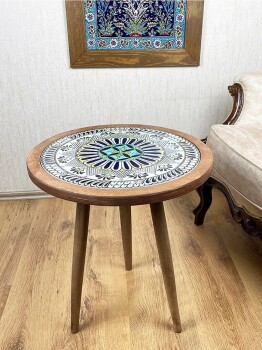
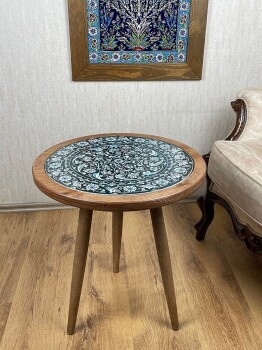
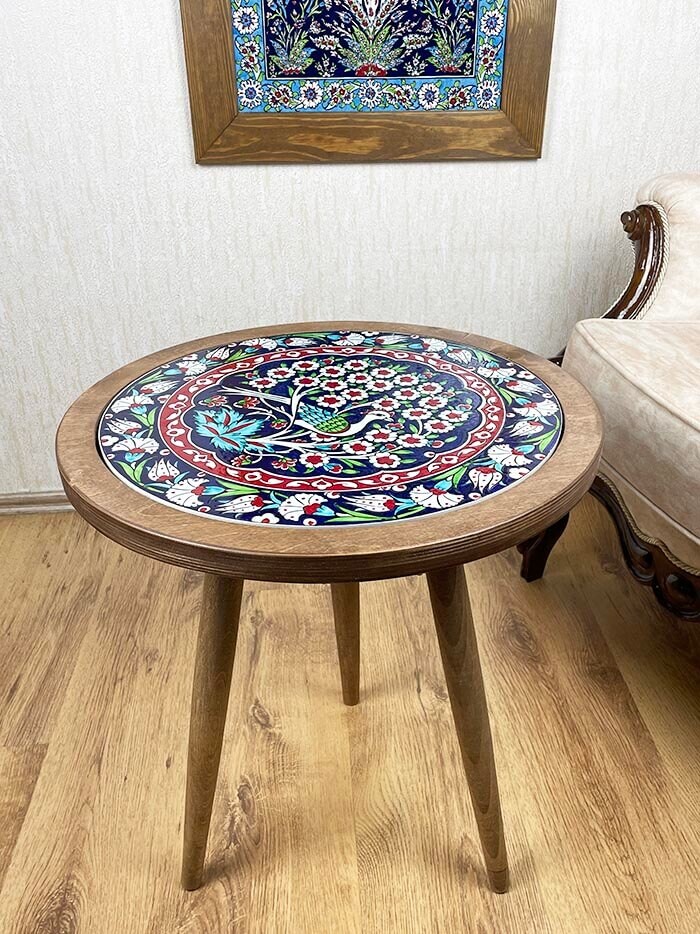
Notify me when it’s in stockWood-framed Iznik ceramic side table.
First-class handmade.
Product Features
Each Iznik ceramic piece is unique, just like a fingerprint. Even if the same product is produced again in the same way, it will not be exactly identical.
The exact same piece you are viewing now cannot be produced again.
We recommend purchasing the product you like immediately if it meets your needs.
The value of Iznik ceramics never decreases, does not go out of fashion, and does not become outdated. It is an artistic heritage piece that can be passed down from generation to generation.
Pattern Information: Meaning of the Paradise Garden Motif
In Iznik ceramics, the paradise garden motif represents the beauty, abundance, and fertility of paradise in Islamic belief. This motif usually includes colorful flowers, fruits, trees, and birds. The flowers, fruits, and trees represent the beauty and abundance of paradise, while the birds represent the peace and happiness of paradise.
The paradise garden motif is one of the most widely used motifs in Iznik ceramics. It has been used in buildings such as palaces, inns, mosques, baths, and homes.
The meaning of the paradise garden motif has an important place not only in Islamic belief but also in Turkish culture. In Turkish culture, paradise is associated with concepts such as abundance, prosperity, peace, and happiness. By representing these concepts, the paradise garden motif has become an important part of Turkish culture.
Beauty: The paradise garden is described as an extremely beautiful place. Therefore, the paradise garden motif represents beauty and elegance.
Abundance: Paradise is accepted as a source of abundance and fertility. Therefore, the paradise garden motif represents abundance and prosperity.
Peace: Paradise is described as a place of peace and happiness. Therefore, the paradise garden motif represents peace and happiness.
Pattern Information: Peacock
In Ottoman culture, the peacock is associated with beauty, eternity, and nobility. The bird’s long tail feathers are seen as symbols of beauty and fertility, while its loud call is seen as a reminder of divine power. The peacock’s ability to shed and regrow its feathers is seen as a symbol of eternity, and its colorful feathers are seen as a symbol of nobility.
The peacock motif first appeared in Iznik ceramics in the 16th century.
In Iznik ceramics, the peacock motif recalled the beauty and power of the Ottoman Empire. The peacock was a symbol of the empire’s wealth and prestige.
The peacock is generally seen as a symbol of beauty, eternity, and royalty.
The long tail feathers of the peacock are seen as symbols of beauty and fertility, while its loud call is seen as a reminder of divine power.
The peacock’s ability to shed and regrow its feathers is seen as a symbol of eternity, and its colorful feathers are seen as symbols of nobility.
The peacock motif remains popular today and appears in ceramics in museums and private collections around the world.
Pattern Information: Tulip
In Iznik ceramics, the tulip is seen as a symbol of love, beauty, and perfection. Because the Turkish word for tulip shares the same letters as the Arabic word “Allah”, it has also been associated with divine love. The tulip motif became especially important in the 16th century.
Love: The tulip is often seen as a symbol of love because of its delicate beauty and graceful form.
Beauty and elegance: The tulip is known in nature as an elegant and aesthetic flower. In Iznik ceramics, tulip motifs emphasize the beauty and elegance of ceramic craftsmanship.
Perfection: The tulip is often seen as a symbol of perfection because of its symmetrical shape and balanced petals.
Divine meaning: Because of its similarity to the Arabic word “Allah”, the tulip is sometimes seen as a divine symbol.
Cycle of nature: The tulip is accepted as a herald of spring. In Iznik ceramics, tulip motifs symbolize natural cycles such as the revival of nature, rebirth, and growth.
Nobility and wealth: The tulip became an important symbol during the Ottoman Empire. Tulip motifs were used in Ottoman palaces and other important buildings, symbolizing nobility, power, refinement, and wealth.
Turkish culture and history: The tulip has an important place in Turkish culture and history. In the Ottoman Empire, tulips were grown in palace gardens and adopted as a symbol. Tulip motifs in Iznik ceramics represent the connection to Turkish history and culture.
Pattern Information: Meaning of the Tree of Life Motif
The tree of life motif is used as a symbol of fertility, abundance, and good luck. It is generally seen as a symbol of the connection between heaven and earth, and it may also represent the cycle of life, death, and rebirth.
In Iznik ceramics, the tree of life is usually depicted with a large trunk and spreading branches. The branches are filled with flowers, fruits, and leaves. The tree of life may be shown in various colors, but the most common colors are blue, white, and red.
The tree of life motif is frequently used in Iznik ceramics to decorate special buildings, offices, and homes. It is a popular design element because it symbolizes many positive meanings, including fertility, abundance, good luck, and the connection between heaven and earth.
Some meanings of the tree of life motif in Iznik ceramics are as follows:
Fertility: The tree of life is a symbol of fertility because it is a living being that grows and bears fruit.
Abundance: The tree of life is a symbol of abundance because it is a source of food and shelter.
Good luck: The tree of life is a symbol of good luck because it recalls the cycle of life, death, and rebirth.
Connection between heaven and earth: The tree of life is a symbol of the connection between heaven and earth because it extends upward toward the sky and downward through its roots.
The tree of life motif is a popular design element in Iznik ceramics because it represents many positive meanings.
In addition to the above, in the eyes of Turkish culture, the tree of life is firmly connected to the earth and worldly life with its roots, while its branches reach toward the sky and spiritual life.
The tree of life is also a symbol of family and means a family tree.