




Tulip and Spring Iznik Ceramic Jewelry Set
Completely handmade Iznik ceramic jewelry set with red tulip and spring patterns.
Product Features
- Ring (adjustable), earrings, bracelet, and pendant.
- First-class handmade.
- Antique silver-plated.
- Produced with the underglaze technique.
- Ceramic stones are fired at 800–1200 °C.
- Shipped in a wooden box.
- For international orders, your product is handed over to the shipping carrier with ultra-protective special packaging. Estimated delivery time is 3–7 business days for European countries and the United States, and 4–9 business days for other countries. Delivery times may vary depending on the shipping carrier, customs procedures, public holidays, and local delivery processes.
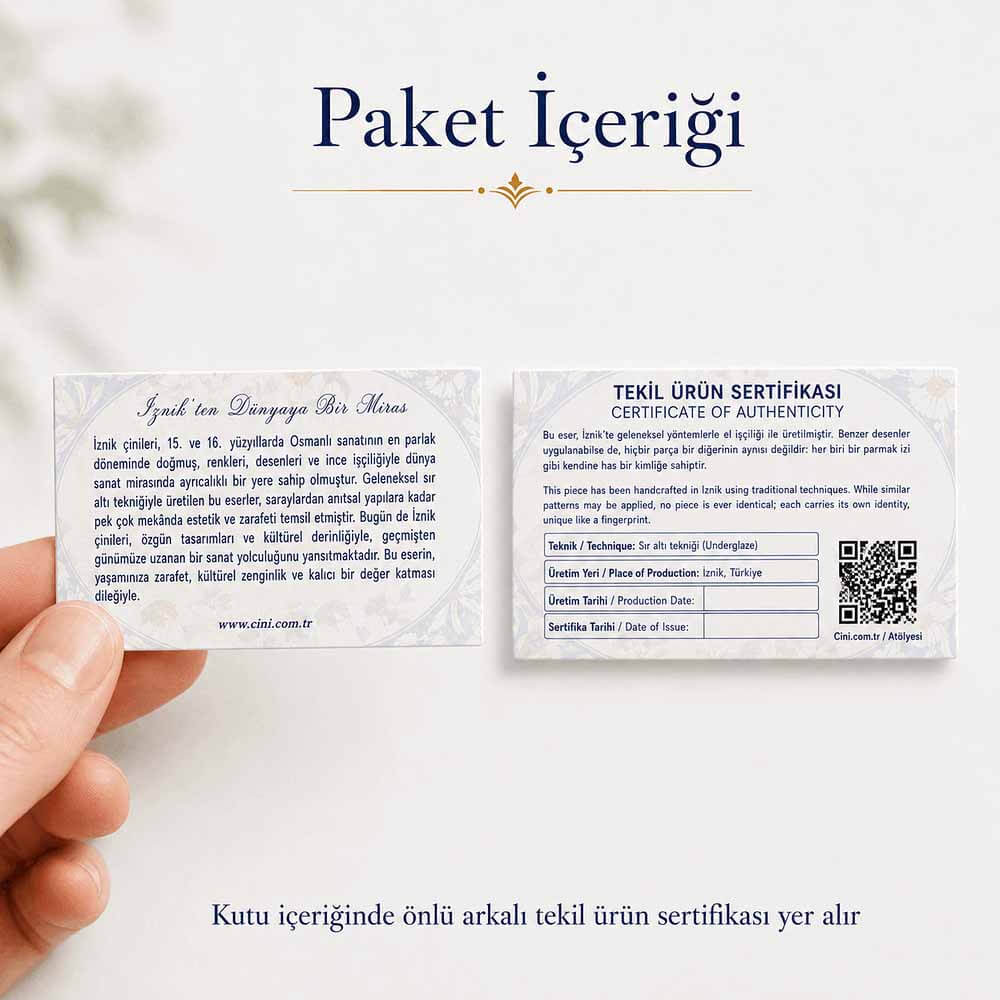
Each Iznik ceramic piece is unique, just like a fingerprint. Even if the same product is produced again in the same way, it will not be exactly identical.
The exact same piece you are viewing now cannot be produced again.
We recommend purchasing the product you like immediately if it meets your needs.
The value of Iznik ceramics never decreases, they never go out of fashion, and they do not become outdated. They are artistic heritage pieces that can be passed down from generation to generation.
Pattern Information: Tulip Motif
In Iznik ceramics, the tulip is seen as a symbol of love, beauty, and perfection. Because the Turkish word "lale" shares the same letters as the Arabic word "Allah," it has also been associated with divine love. 16th century.
Love: The tulip is often seen as a symbol of love because of its delicate beauty and graceful form.
Beauty and elegance: The tulip is known as an elegant and aesthetic flower in nature. In Iznik ceramics, tulip motifs emphasize the beauty and elegance of ceramic craftsmanship.
Perfection: The tulip is often seen as a symbol of perfection because of its symmetrical shape and even petals.
Divine meaning: The tulip is sometimes seen as a divine symbol because of its similarity to the Arabic word "Allah".
Cycle of nature: The tulip is accepted as a herald of spring. In Iznik ceramics, tulip motifs symbolize natural cycles such as the revival of nature, rebirth, and growth.
Nobility and wealth: The tulip became an important symbol during the Ottoman Empire. Tulip motifs were used in Ottoman palaces and other important buildings, symbolizing nobility, power, refinement, and wealth.
Turkish culture and history: The tulip has an important place in Turkish culture and history. In the Ottoman Empire, tulips were grown in palace gardens and adopted as a symbol. Tulip motifs in Iznik ceramics represent the connection to Turkish history and culture.
Pattern Information: Carnation Motif
In Turkish culture, the carnation is associated with love, beauty, and passion. It is also seen as a symbol of fertility and abundance. The bright colors and delicate petals of the carnation make it a beautiful and eye-catching addition to any Iznik ceramic design.
The carnation was first introduced to Turkey in the 16th century and quickly became a popular flower in Ottoman culture.
The carnation was often used in Iznik ceramics as a symbol of love, beauty, and passion.
The bright colors and delicate petals of the carnation make it a beautiful and eye-catching addition to any Iznik ceramic design.
The strong stems and firm petals of the carnation make it a durable and long-lasting decoration.
It is often used in Iznik ceramics as a reminder of the country's rich cultural heritage.


