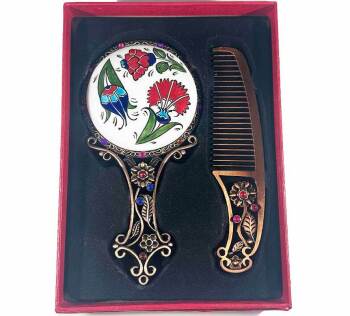
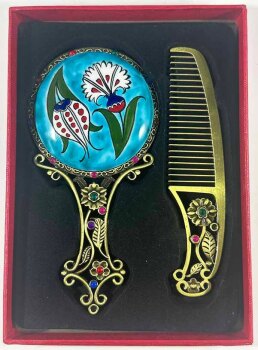
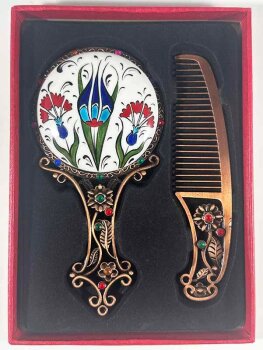
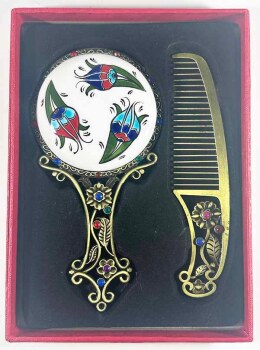
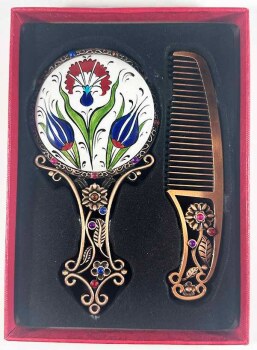
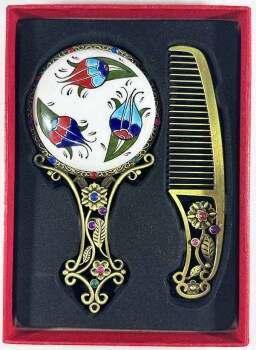
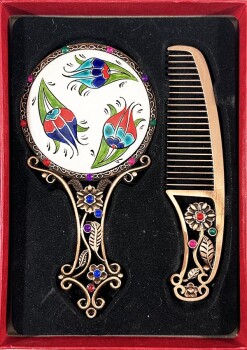
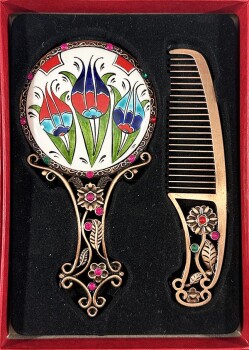
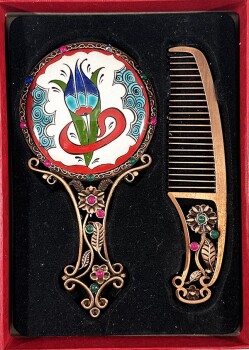
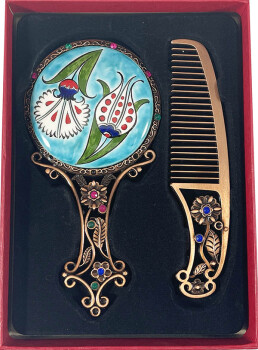
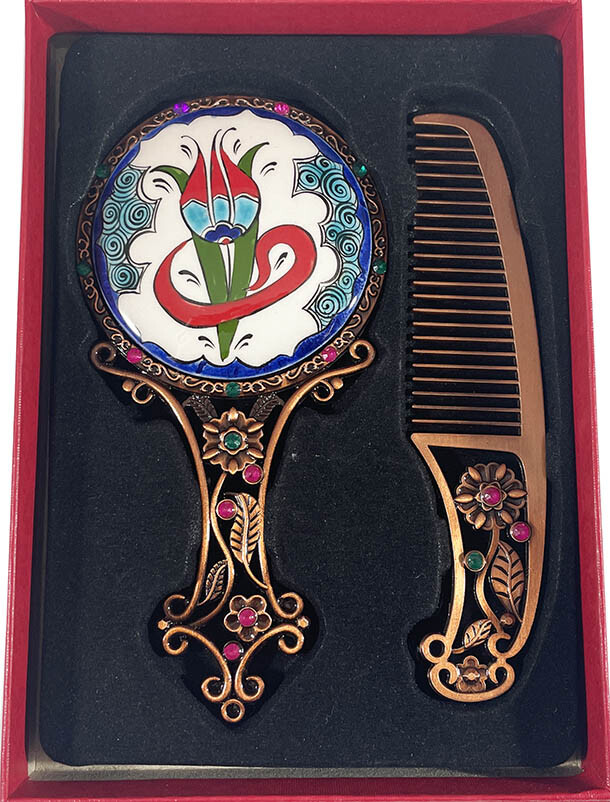
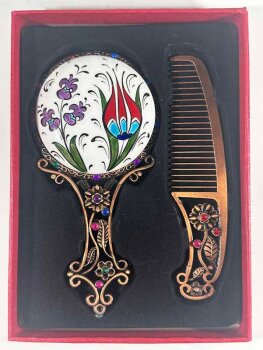
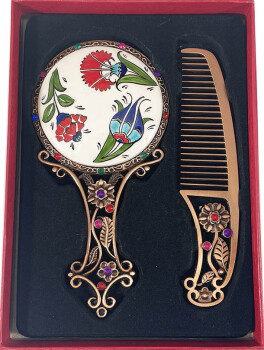
Every Iznik ceramic piece is unique, just like a fingerprint. Even if the same product is produced again with the same design, it will not be exactly identical.
The exact same piece you are viewing now cannot be reproduced in precisely the same way.
Iznik ceramics are timeless cultural artworks. They do not lose their artistic value, go out of style or become obsolete; they can be kept as a heritage piece to pass from one generation to the next.
The Elif motif in Iznik ceramics represents the first letter of the Arabic alphabet. Because it is also the first letter of the word Allah, it has an important place in Islamic symbolism and adds elegance to Iznik ceramics.
Belief in one God: The Elif motif represents the monotheistic belief of Islam. Its single upright line symbolizes that Allah is one and unique.
Unity of existence: The Elif motif represents the unity of existence and Allah as the source of all things. Its single line suggests that all existence comes from and is connected to Allah.
Grandeur and majesty: The upright and long form of Elif symbolizes the greatness, majesty and infinite power of Allah.
Spiritual elevation: The upward form of Elif represents spiritual elevation and the effort to come closer to Allah.
The Elif motif is not only religious in meaning; it also carries aesthetic value. Its simple and graceful form gives Iznik ceramics a refined beauty.
The Vav motif in Iznik ceramics represents the sixth letter of the Arabic alphabet. Because it is also associated with words such as existence and unity, it has an important place in Islamic symbolism and adds elegance to Iznik ceramics.
Existence: The Vav motif represents the unity of existence and Allah as the source of all things. Its form may symbolize the material and spiritual dimensions of existence.
Unity: The Vav motif represents unity and togetherness. The joining of its lines can symbolize the unity of Allah and the unity of believers.
Love: The Vav motif can represent love for Allah and creation. Its curved form is often interpreted as a symbol of embrace, affection and devotion.
Elevation: The Vav motif may also represent spiritual elevation and the effort to come closer to Allah.
Like the Elif motif, the Vav motif is not only religious in meaning; it also carries aesthetic value. Its graceful and simple design gives Iznik ceramics a distinctive beauty.
In Iznik ceramic art, the tulip is seen as a symbol of love, beauty, elegance and perfection. Because the Turkish word “lale” shares the same letters as the Arabic word “Allah,” it has also been associated with divine love.
Love: The tulip is often viewed as a symbol of love because of its delicate beauty and graceful form.
Beauty and elegance: As an elegant flower in nature, the tulip highlights the beauty and refinement of Iznik ceramic craftsmanship.
Perfection: Because of its balanced form and symmetrical structure, the tulip can symbolize perfection.
Divine meaning: Due to its letter association with the word Allah, the tulip is sometimes interpreted as a sacred or spiritual symbol.
Cycle of nature: As a herald of spring, the tulip represents awakening, renewal, rebirth and growth in nature.
Nobility and richness: During the Ottoman period, the tulip became an important symbol and was used in palaces and major buildings to express nobility, refinement, power and wealth.
Turkish culture and history: Tulips hold an important place in Turkish culture. In the Ottoman Empire, tulips were cultivated in palace gardens and became an enduring cultural symbol.
In Turkish culture, the carnation is associated with love, beauty and passion. It is also seen as a symbol of fertility, abundance and prosperity.
With its bright colors and delicate petals, the carnation adds a striking and graceful contribution to Iznik ceramic designs.
The carnation was introduced to Turkiye in the 16th century and quickly became a popular flower in Ottoman culture.
In Iznik ceramics, the carnation has often been used as a symbol of love, beauty and passion. Its vivid colors and elegant leaves make it an eye-catching motif.
The strong stems and durable leaves of the carnation also make it a symbol of lasting beauty and enduring decoration. It is frequently used in Iznik ceramics as a reminder of the country’s rich cultural heritage.